Command & Control Centre — Technology Framework | CICA | Transforming Nations
Centre for IT, Cybersecurity and Artificial Intelligence · CICA

Command & Control Centre

Technology Framework

  • One platform
  • Connected agencies
  • Real-time intelligence
  • Secure nation

A reference architecture for national command and control — integrated, intelligent, interoperable, secure and resilient. It takes what the field sees, what agencies hold and what the open world publishes, and turns it into one picture that decision-makers can act on.

Why the framework exists

Command centres rarely fail on hardware.

They fail on the joins — between systems, between agencies, between the technology and the people expected to run it. The framework is built around those four failure points, and each one is answered by a specific layer.

Data that never meets

Feeds stay in the system that collected them. The picture exists, in pieces, in five different places.

Answered by Layer 3

Agencies that cannot talk

Each service holds a view of the same incident. No one holds the whole of it, and no one can hand it over cleanly.

Answered by Layer 2

Security added last

Controls bolted on after go-live are bolted on too late — and the data being protected is national.

Answered by the security layer

A room nobody is trained to run

Consoles without operators, shift discipline or written procedure produce screens, not decisions.

Answered by Layer 7
The blueprint

Seven layers. One architecture.

Inputs feed the platform, the working stack sits at the centre, security wraps every layer of it, and the disciplines and people that keep it running sit underneath. Every element here is expanded in its own section below.

1Data & Input Sources
Field Operations
Sensors & IoT
Enterprise Systems
External Databases
Public & Open Data

Every source enters through the integration platform in Layer 3.

2Command & Control Application Layer
Real-time Situational Awareness
Monitoring & Surveillance
Incident Management
Case & Investigation Management
Resource & Deployment Management
Border & Movement Management
Analytics & Reporting
Executive Dashboards
Communication & Collaboration
3Data & Integration Platform
Data Ingestion
Data Lake
Data Processing
Master Data Management
Integration & API Management
4Core Infrastructure Layer
Data Centre
Cloud Infrastructure
Network
High Availability
Backup & DR
Power & Environment
5Enabling Services Layer
GIS & Mapping
AI & Machine Learning
Video Management (VMS)
Notification & Alerts
Workflow & Rules Engine
Document & Records
6Cross-Cutting Capabilities
Interoperability Standards
Data Governance & Quality
Scalability & Performance
Resilience & Continuity
Monitoring & Observability
Change & Release Management
7Operations & People
24/7 Command Centre Operations
Skilled Personnel
Training & Capacity Development
SOPs & Standard Operating Procedures
Cybersecurity Layer
Network Security
Endpoint Security
Identity & Access Management
Data Security
Security Operations
Compliance & Governance

Applied across every layer, not positioned between them.

  • Inputs into the platform
  • Numbered stack layer
  • Spans every layer
Supported agencies

Shared platform. Distinct mandates.

Each service runs its own operations on the platform and contributes to the picture the others depend on. The capabilities listed are drawn from the framework's own application layer.

Agency Customs Service
  • Border & movement management
  • Case & investigation management
  • Analytics & reporting
Agency NSCDC
  • Real-time situational awareness
  • Incident management
  • Resource & deployment management
Agency Correctional Service
  • Monitoring & surveillance
  • Case & investigation management
  • Document & records management
Agency Immigration Service
  • Border & movement management
  • External database checks
  • Executive dashboards
Extensible Other security & government agencies
  • Onboarded through the integration layer
  • Access governed by role and mandate
01Layer

Data & Input Sources

Everything the centre knows begins here — from an officer's handset at a checkpoint to a query against a national register.

Field Operations

Mobile apps, tablets, bodycams, drones.

Sensors & IoT

CCTV, ANPR, GPS, alarms, environmental sensors.

Enterprise Systems

HR, finance, asset management, case management, permits.

External Databases

NIN, BVN, watchlists, Interpol, other agencies.

Public & Open Data

Social media, news, GIS, weather, maps.

02Layer

Command & Control Application Layer

The nine capabilities operators, investigators and commanders work in every day. This is the visible surface of the whole platform — and the only layer most users will ever name.

Real-time Situational Awareness

One live operating picture, shared across agencies and locations.

Monitoring & Surveillance

Continuous watch over feeds, sites and assets of interest.

Incident Management

From first report to closure, with a complete audit trail.

Case & Investigation Management

Evidence, actions and outcomes held together in one record.

Resource & Deployment Management

What is available, where it is, and where it should go next.

Border & Movement Management

Movement of people and goods tracked across entry points.

Analytics & Reporting

Operational and strategic reporting, on demand.

Executive Dashboards

Command-level views for leaders who need the position, fast.

Communication & Collaboration

One channel for every agency working the same incident.

03Layer

Data & Integration Platform

The pipeline that turns many agencies' raw feeds into one trusted, queryable source of truth. Each stage feeds the next.

01

Data Ingestion

APIs, streaming, connectors, ETL.

02

Data Lake

Structured and unstructured raw data storage.

03

Data Processing

Stream processing and batch processing.

04

Master Data Management

Entity resolution and data quality.

05

Integration & API Management

ESB, API gateway, microservices.

04Layer

Core Infrastructure Layer

A command centre is only as dependable as what it runs on. This layer is engineered so the links, the power and the data stay up.

Data Centre

Compute, storage, virtualisation.

Cloud Infrastructure

Private / government cloud, hybrid cloud.

Network

LAN, WAN, SD-WAN, 5G/LTE, MPLS.

High Availability

Clusters, load balancers, auto failover.

Backup & DR

Backup, replication, disaster recovery.

Power & Environment

UPS, generators, cooling, monitoring.

Spans all

Cybersecurity Layer

Security is applied across the whole stack rather than inserted at one point in it — from the network edge to the audit record, and from the device in the field to the executive dashboard.

Network Security

Firewalls, IDS/IPS, VPN, network segmentation.

Endpoint Security

EDR, anti-malware, device hardening.

Identity & Access Management

RBAC, MFA, SSO, PAM.

Data Security

Encryption in transit and at rest, DLP.

Security Operations

SIEM, threat intelligence, 24/7 monitoring.

Compliance & Governance

Policies, standards, audit, risk management.

05Layer

Enabling Services Layer

Shared services every application draws on — built once, governed centrally, used everywhere.

GIS & Mapping Services

Location treated as a first-class dimension of every event.

AI & Machine Learning Services

Pattern detection, prediction and decision support.

Video Management System (VMS)

Centralised video capture, retention and retrieval.

Notification & Alert Services

The right message to the right responder, immediately.

Workflow & Business Rules Engine

Procedure encoded, so response does not depend on memory.

Document & Records Management

Records held to evidentiary and archival standards.

06Layer

Cross-Cutting Capabilities

The disciplines that decide whether the platform still holds up in year five — not just on the day it is commissioned.

Interoperability Standards

NG-IF, NIEM, ISO, OGC.

Data Governance & Quality

Ownership, definitions and warranted trust in the data.

Scalability & Performance

Capacity that grows with demand rather than after it.

Resilience & Business Continuity

Degraded modes instead of outages.

Monitoring & Observability

Know the health of the platform before its users do.

Change & Release Management

Controlled change on a live operational system.

07Layer

Operations & People

Technology does not run a command centre. Trained people, working to written procedure, around the clock, do.

24/7 Command Centre Operations

Continuous watch, shift handover and escalation.

Skilled Personnel

Operators, analysts and engineers.

Training & Capacity Development

Capability built and kept current, not assumed.

SOPs & Standard Operating Procedures

One documented way to respond — tested, and followed.

Outcomes & benefits

What the architecture is judged on.

Architecture is a means. These seven are the ends — and the terms on which any implementation should be reviewed.

Faster decision making

Commanders act on the current position, not yesterday's report.

Coordinated operations

Agencies work the same incident from the same picture.

Improved situational awareness

What is happening, where, and what it means — as it happens.

Operational efficiency

Resources deployed where they change the outcome.

Enhanced security & safety

Threats seen earlier and answered sooner.

Accountability & transparency

Every action logged, reviewable and auditable.

Better service delivery

Citizens experience an institution that responds.

Working with CICA

From framework to functioning room.

The framework is the reference. Getting from it to a command centre that agencies actually use follows three stages.

01

Assess

Establish what exists today — systems, feeds, networks, security posture, standards in use and the gaps between agencies.

02

Design

Set the target architecture against the seven layers: integration model, security controls, interoperability standards and operating model.

03

Stand up

Build, integrate and commission — then train the operators, write the procedures and hand over a room that runs.

The commitment

One platform. One picture. One nation secured.

CICA works with agencies and governments on command and control capability — architecture, interoperability, security operations, and the people who run the room.

  • Integrated
  • Intelligent
  • Interoperable
  • Secure
  • Resilient
Framework diagrams

View and download the full framework.

Both diagrams are published in full resolution for briefings, proposals and internal circulation. Open one to read it at full size, or download the file.

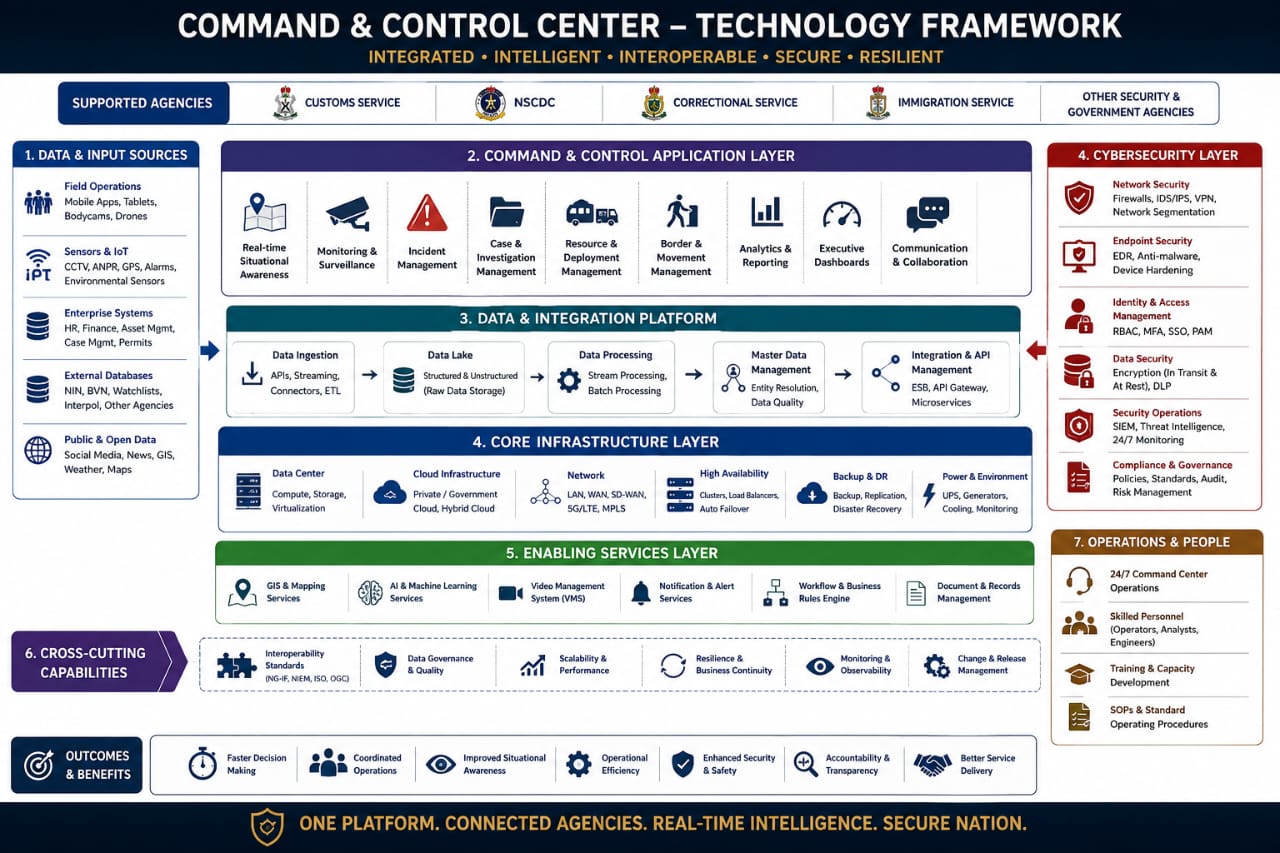
Command and Control Centre Technology Framework diagram — seven architectural layers, supported agencies and outcomes
Diagram 01

Command & Control Centre — Technology Framework

The architecture set out on this page in a single view: input sources, the seven-layer stack, the cybersecurity layer spanning all of it, supported agencies and the outcomes it delivers.

Landscape · full resolution

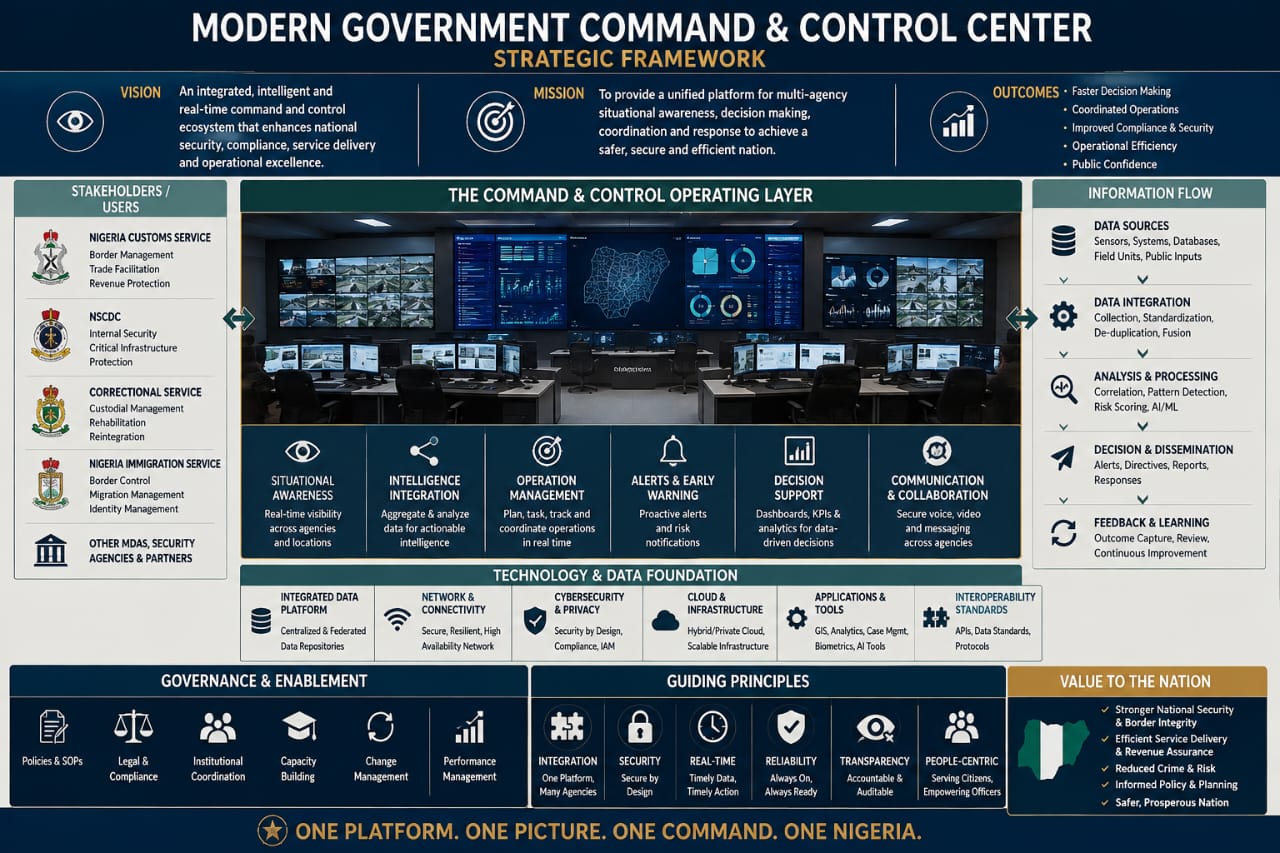
Modern Government Command and Control Centre Strategic Framework diagram — vision, mission, stakeholders, operating layer, governance and value to the nation
Diagram 02

Modern Government Command & Control Centre — Strategic Framework

The strategic companion view: vision and mission, stakeholder agencies and their mandates, the operating layer, information flow, governance and enablement, guiding principles and value to the nation.

Landscape · full resolution